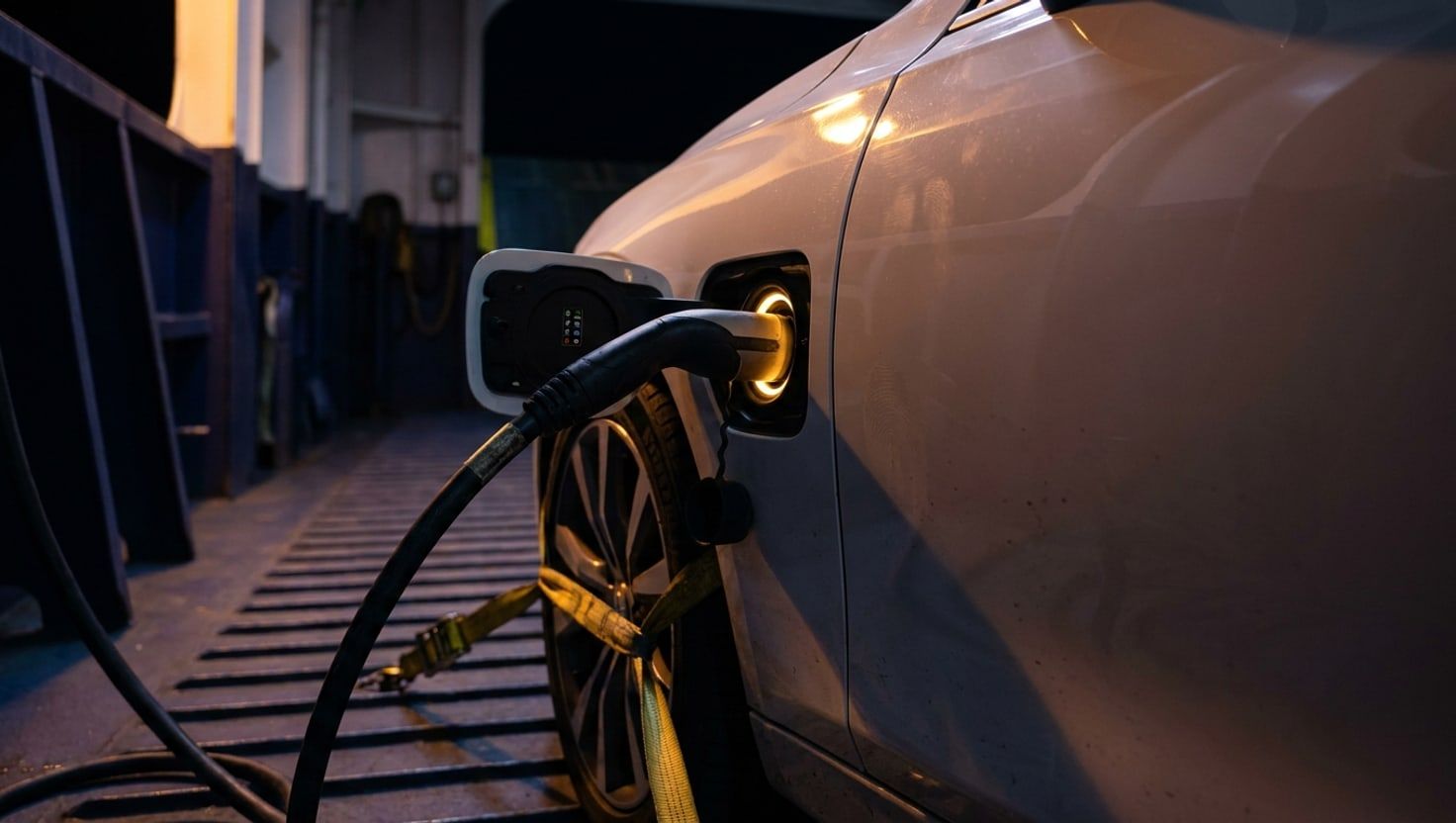

With EVs growing fast in Malaysia, this question comes up more and more: "Can I ship an electric car to Sabah/Sarawak?" The answer is yes — but by container, not RoRo. RoRo vessels to Sabah/Sarawak don't accept EVs due to lithium-battery fire safety. Here's what matters.
Can You Ship an EV?
Yes — but by container. RoRo vessels to Sabah/Sarawak don't accept electric cars due to lithium-battery fire safety, so the EV is loaded inside an enclosed container. Aside from the loading method, the process is similar: pickup → inspection → load into container → sailing → clearance & delivery.
Battery Considerations
- 🔋 Moderate charge level: as a safety practice, EVs are usually shipped with the battery at a moderate level (not full, not empty) — enough to drive on/off the vessel.
- 🚗 Transit mode: turn off unnecessary systems; make sure the car can go into neutral/tow mode if needed.
- 🛡️ Safe handling: the EV is lashed and handled like any other vehicle. We confirm charge requirements at booking.
Why a middle level rather than an empty one? A container booking has a longer runway than RoRo. Vehicles going into a container are dropped off roughly 48–72 hours before sailing — against about 24 hours for a RoRo booking — because the container still has to be stuffed and sealed at the stuffing yard before it ever reaches the wharf. Your EV therefore sits, then sails, then waits again at the far end while the box is craned off and unpacked. A pack that starts near empty can easily arrive at the point where the car won't move under its own power, and a vehicle that can't start, steer or brake stops being a routine drive-in job for the yard. That is the entire reason for the middle ground: enough charge to be driven into the container at Port Klang and driven back out in Borneo, with margin on both sides.
Documents & Permits
No special permit for a private EV — the documents are the same as a normal car: registration (VOC), owner's IC, valid road tax & insurance, and a booking form. If the EV is still under loan, include a bank release letter. Full list: documents to ship a car.
Why EVs Ship by Container (Not RoRo)
For the Sabah/Sarawak route, RoRo vessels don't accept EVs — lithium batteries are classed as a fire risk on board, so the domestic RoRo operators won't load electric cars. EVs therefore ship by container (fully enclosed), which also gives better protection. See how the methods differ in the RoRo vs container guide. The container rate depends on vehicle size — check with our officer.
There is a consolation inside the constraint. A sealed container is the more protective of the two methods no matter what is riding in it: your EV crosses enclosed in steel, out of reach of salt air and sea spray, with no chance of contact damage from vehicles parked alongside, and behind a customs seal that has to still be intact on arrival. Owners of high-value cars pay a premium for exactly that. As an EV owner you get it as the standard method — which counts for more than usual on a monsoon-season crossing, when the sea is rougher and salt spray is at its heaviest.
What a Container Booking Changes
Because an EV can't travel by RoRo, what you're really booking is a container shipment — and a few things shift from the owner's side. None of them are difficult, but it's better to know them now than to meet them at the counter.
- 📄 Extra paperwork: the vehicle documents stay the same (registration, IC, road tax, insurance). What gets added is a packing list for anything you declare, plus a Bill of Lading. We prepare both — you simply sign the BL at handover.
- 🎒 Personal belongings: RoRo forbids personal items in the vehicle outright, whereas a container allows goods that are declared to customs. If you're relocating alongside the EV, that's genuinely an advantage — provided everything is declared rather than tucked away.
- ⏳ Sailing time: on the same lane, container typically runs a little longer than RoRo. The gap is small, but build it into your plan if you need the car by a fixed date.
- 💰 Rate follows space: a container is priced by the space your vehicle occupies rather than RoRo deck lane-metres. For multi-vehicle moves, two cars can share a 40-foot container with internal racking, and the cost is split between them.
Beyond those four points, the workflow is the same as any other vehicle shipment we handle: a joint inspection with you at pickup, photos for the record, the sailing, then clearance and delivery at the destination.
What to Prepare Before Drop-Off
None of this is EV-specific paperwork — it's the ordinary vehicle checklist. What changes is the timing, because a container asks for the car earlier than RoRo does. Work backwards from your sailing date rather than forwards from today.
- 🏦 Bank release letter first, if the EV is financed. Under hire-purchase the financing bank is the registered owner, so it has to issue the release letter itself. It usually takes 3–7 working days — request it at least two weeks ahead. This one document is the most common reason a shipment stalls.
- 🛡️ Road tax and motor insurance valid through transit. Your EV is driven at the port and into the container at one end, and out of it at the other, so both have to be valid on those days — not merely on the day you book. Check your road tax and vehicle registration status with the Road Transport Department Malaysia (JPJ).
- ✍️ An authorisation letter if you aren't the registered owner named on the VOC — for example when a family member hands the car over on your behalf.
- 🎒 Decide on belongings before you arrive, not at the counter. Anything travelling inside the car has to appear on the packing list and be declared to customs. Deciding at drop-off is what turns a straightforward container booking into a slow one.
The full checklist, including the cases where a document is or isn't needed, lives in our documents guide. Get those four right and the EV-specific part of the job is genuinely just the charge level.
Two questions come up constantly, and both answers are reassuring. First, there is no special permit for a private EV — for registration purposes it is treated as an ordinary passenger car, so the document set is exactly the same as it would be for a petrol model. Second, weight: an EV does tend to be somewhat heavier than the equivalent petrol car, but the great majority of electric sedans and SUVs still sit inside the same vehicle class, so there is no separate price band simply for being electric. For unusually large or heavy models, confirm the class with our officer at quotation stage so nothing is a surprise on handover day.
Charging at the Destination
Your EV arrives with enough charge to be driven off and to your address. After that, charge as usual at home or public charging stations — the EV charging network in Kota Kinabalu, Kuching, and major Borneo towns is expanding. Plan your first charge location ahead for peace of mind.
FAQ
Can you ship an electric car (EV) to Sabah/Sarawak?
Yes — but EVs must ship by CONTAINER, not RoRo. RoRo vessels to Sabah/Sarawak don't accept EVs due to lithium-battery fire safety. The other documents and process are much like a regular car; we confirm the details at booking.
Should the battery be full or empty?
As a safety practice, EVs are usually shipped with a moderate battery charge (not full). Make sure there's enough power to drive on/off the vessel. We confirm the recommended level at booking.
Is there a special permit for EVs?
No special permit for a private EV — it's treated as a normal passenger car. Same documents: registration, IC, valid road tax & insurance, booking form (+ bank release letter if under loan).
Is my EV insured during transit?
Yes. Marine Insurance covers your EV throughout transit (billed separately, per Insured Value), just like any other vehicle. Your normal motor insurance still applies for on-road driving.
Can I charge my EV after it arrives?
Your EV arrives with enough charge to be driven off and to your address. After that, charge as usual at home or public charging stations in Sabah/Sarawak.
EVs are heavy — is there a surcharge?
EVs tend to be a bit heavier. Most EV sedans/SUVs fall under the normal vehicle class, but for certain models, check with our officer for an exact rate.
⚡ Ready to ship your EV?
Tell us your EV model + destination, and we'll confirm the battery requirements and an exact rate — Marine Insurance is billed separately (per Insured Value).
// Rentaka Logistics — vehicle shipping since 2023