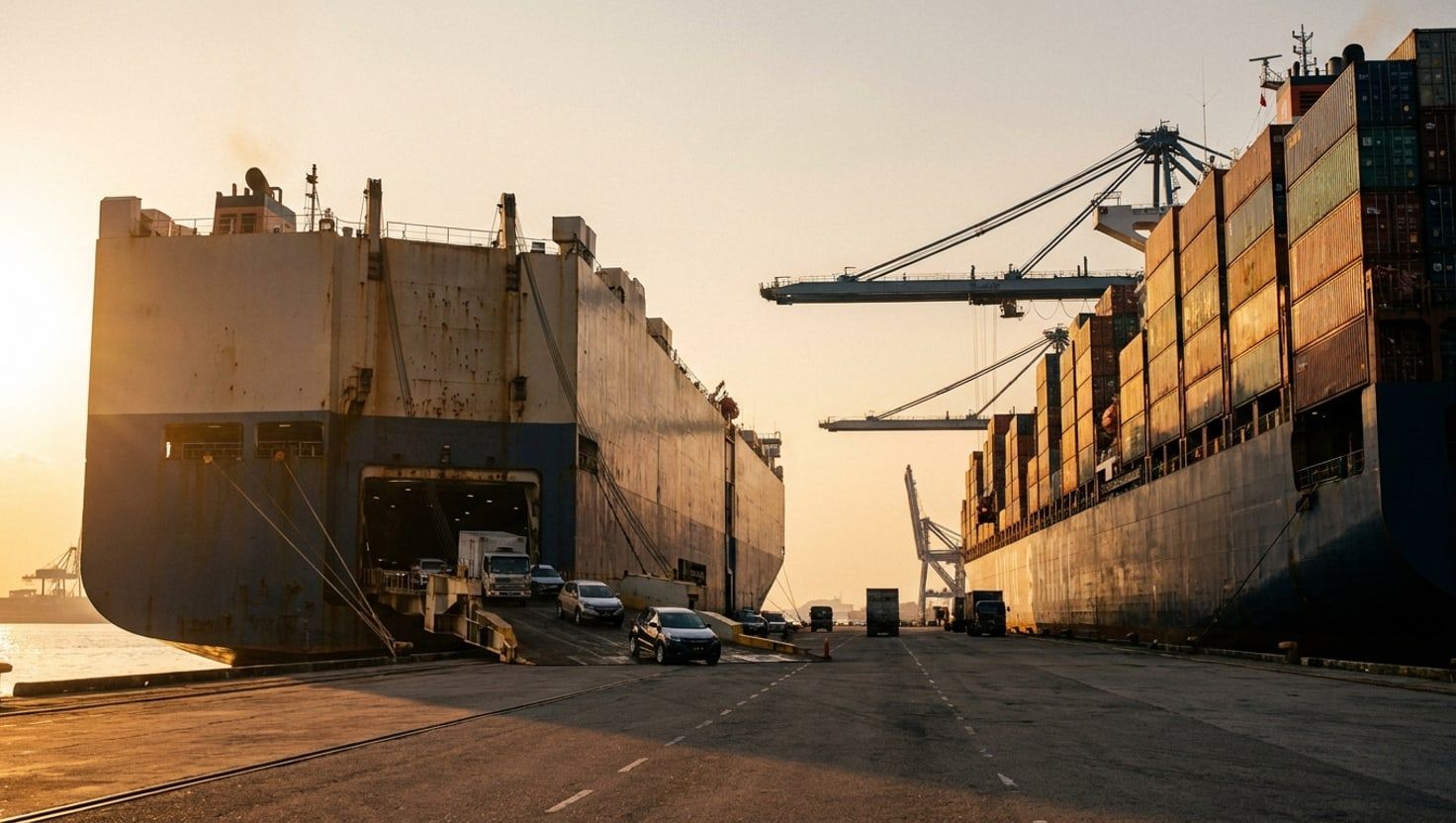

When you ship a vehicle from Port Klang to Sabah or Sarawak, you have exactly two practical methods: RORO shipping (roll-on, roll-off) or container shipping. Each has a place, but most customers don't actually know which one fits their situation.
This guide is the side-by-side answer. We'll cover what each method actually does, what they cost on the Klang ↔ Kuching corridor, how long they take, what they protect against, and the five-minute decision framework we use at Rentaka when a customer calls asking which to pick.
- 🚗 Anyone shipping a passenger car, SUV, or commercial van across the South China Sea
- 💎 Luxury-vehicle owners weighing extra protection vs cost
- 🔧 Owners of non-running or project vehicles that can't drive onto a ramp
- 📦 Businesses moving multiple vehicles or vehicles with personal effects inside
What is RORO Shipping?
RORO stands for roll-on, roll-off. The vessel is a specialised car carrier with multiple internal decks — essentially a floating multi-storey car park. Your vehicle is driven up the stern ramp, manoeuvred into a parking bay, and chained to the deck for the voyage.
On the Port Klang ↔ Sabah/Sarawak corridor, RORO is the workhorse method. RORO sailings from Westport to Kota Kinabalu and Bintulu use a RORO vessel — Kuching is currently served via Bintulu with a road leg. The same kind of ship that moves new Proton, Perodua, and Honda cars from the factory also moves your private vehicle. We keep a longer primer on what RORO shipping is for readers who want the vessel and terminal detail rather than the comparison.
Whichever method you end up on, the surrounding shipment is identical — the same yard inspection, paperwork, and discharge sequence described in our 13-step car shipping process.
How RORO Loading Works
- 🚗 Drive-on — your vehicle is driven onto the deck by a stevedore (port worker), not by you
- 🔗 Lash-down — straps and chains anchor the vehicle to deck rings, with timber wedges under the wheels
- 🚪 Stern ramp closes — the entire car deck becomes a sealed compartment for the voyage
- ⚓ Sea transit — typically 5-7 days Klang → Kota Kinabalu; to Kuching, RORO sails to Bintulu and continues by road (10–14 days end-to-end)
- 🛬 Drive-off — at destination, stevedores reverse the process and drive your vehicle off
What is Container Shipping?
Container shipping packs your vehicle into a standard 20-foot or 40-foot steel shipping container — the same kind that carries every other type of cargo on the world's container ships. The vehicle is driven into the box, secured inside, the doors close, and a customs seal is applied.
For Malaysia → East Malaysia, the 20-foot container is the standard for a single sedan or hatchback. A 40-foot accommodates an SUV with significant space, or two compact cars stacked using internal racking.
How Container Loading Works
- 📦 Container positioning — empty 20ft or 40ft container brought to loading bay at Port Klang
- 🚗 Drive-in — your vehicle is driven into the container along internal tracks
- 🔒 Lash-down inside — ratchet straps and wheel chocks secure the vehicle inside the steel box
- 🛂 Customs seal — door bolted, customs seal applied, container ID logged (personal effects must be declared to the Royal Malaysian Customs Department)
- 🏗️ Crane onto vessel — gantry crane lifts the sealed container onto a container ship
- ⚓ Sea transit — containers sail direct to Kuching; transit time confirmed by our officer at quote time
Cost Comparison: RORO vs Container
The biggest single difference is price. RORO is typically 20–30% cheaper than container shipping on direct RORO lanes such as Klang ↔ Kota Kinabalu or Bintulu; for Kuching, RORO via Bintulu is still cheaper but the gap is smaller. Here's the breakdown for a standard passenger sedan:
The container premium pays for: the container itself (rental), more port handling (crane in + crane out), longer dwell time, and extra insurance complexity. None of those are bad — they're just costs RORO doesn't have.
Speed Comparison: Handling vs Routing
RORO involves less handling at the port. For Kuching the routing differs — RORO goes via Bintulu and road, containers sail direct to Kuching Port:
| Phase | RORO | Container |
|---|---|---|
| Port arrival → vessel loading | Same day | 1-2 days (container stuffing) |
| Sea routing (Klang → Kuching) | To Bintulu, then by road | Direct to Kuching |
| Vessel arrival → ready for collection | Same day | 1-2 days (container unloading) |
| Total Klang → Kuching | 10–14 days | On request |
At the port, RORO wins because the car drives off without waiting for a gantry crane. For Kuching, though, containers sail direct while RORO goes via Bintulu with a road leg — our officer confirms which suits your dates.
Protection Level: This Is Where Container Wins
Container shipping wins decisively on physical protection. Your vehicle spends the entire voyage sealed inside a steel box, with no exposure to outside air, salt spray, or contact with other vehicles. The container itself absorbs any minor knocks during transhipment.
What Container Protects Against
- ✅ Salt-air corrosion on chrome, brightwork, and undercarriage
- ✅ Sea spray on paintwork (especially during monsoon crossings)
- ✅ Contact damage from other vehicles on the same deck
- ✅ Theft & tampering — the customs seal must remain intact
- ✅ Personal effects inside vehicle — allowed (subject to customs declaration)
What RORO Protects Against
- ✅ Weather above — the car deck is fully roofed, no direct rain or sun
- ✅ Sea waves — vehicles are on internal decks well above the waterline
- ⚠️ Side ventilation means some salt air can reach the car deck during transit
- ⚠️ Adjacent vehicles — your car is parked alongside dozens of others; rare but possible bump damage
Vehicle Compatibility — The Hard Constraint
Sometimes the choice is made for you. RORO has a hard requirement that container shipping doesn't.
RORO Requires Drivable Vehicles
The whole point of RORO is that stevedores drive the vehicle on and off the ship. If your vehicle cannot start, cannot steer, or cannot brake, RORO is impossible. The port simply won't accept it.
Vehicles that typically need container shipping instead:
- 🔧 Project / restoration cars with engine out, suspension off, or wiring incomplete
- 🔋 Vehicles with completely flat batteries that can't be jumped reliably
- 🚫 Cars with seized engines, broken transmissions, or no brakes
- 📦 Vehicles where the owner wants personal effects shipped inside (RORO bans this; container allows declared items)
When to Choose RORO
Choose RORO if any of these describe your shipment
- ✅ Standard passenger car (sedan, hatchback, SUV, MPV) in normal working condition
- ✅ You want the cheapest method on the corridor (20-30% saving)
- ✅ You want the simplest handling — drive on, drive off, no container stuffing
- ✅ You need frequent sailings (RORO sails 2× weekly; container is less flexible)
- ✅ Vehicle value is under RM 150,000 — the container premium is hard to justify
- ✅ You're shipping a motorcycle, van, lorry, or any wheeled cargo that can drive
This covers ~85% of customers we ship to East Malaysia. RORO is the default choice for good reason.
When to Choose Container
Choose Container if any of these describe your shipment
- ✅ Luxury vehicle worth RM 150,000+ — Mercedes, BMW, Audi, Lexus, Porsche
- ✅ Classic, vintage, or fully-restored vehicle where any cosmetic damage is unacceptable
- ✅ Non-running, project, or partially-dismantled vehicle
- ✅ Concours-grade paint or wrap that you don't want exposed to salt air
- ✅ You want to ship personal effects inside the vehicle (must be declared to customs)
- ✅ You're moving 2+ vehicles and a 40ft container makes sense as a cost-share
Container is the right call for the remaining ~15% of shipments — premium vehicles, edge cases, and non-drivable cars.
RORO vs Container at Port Klang
Both methods use Port Klang's Westport terminal on Pulau Indah, but different parts of it. RORO sailings use the dedicated car-carrier berths at Wharf 14-15. Container shipping uses the main container terminal with its giant gantry cranes.
Wharf 14-15 · Westport
- 🚢 Dedicated car-carrier terminal
- 📅 Sailings to Kota Kinabalu and Bintulu (Kuching via Bintulu), subject to the current schedule
- ⏰ Vehicle drop-off cutoff: 24 hours before sailing
- ⚓ Operated by Northport / MISC / equivalent carriers
CT1–CT9 · Westport
- 🏗️ Container stuffing yards adjacent to terminals
- 📅 Sailings depend on container vessel rotations (2-3 per week)
- ⏰ Vehicle drop-off cutoff: 48-72 hours before sailing (extra stuffing time)
- 🛃 Customs seal applied at the stuffing yard, not at the wharf
FAQ
1. Is RORO shipping safe for new cars?
Yes. RORO is how every new Proton, Perodua, Honda, Toyota, and Mercedes reaches its dealer in East Malaysia. The same vessels and same stevedores handle your private vehicle. For premium / luxury cars, container is an upgrade option, but RORO is industry-standard safe for new cars.
2. Can I leave belongings in my car if I ship RORO?
No. RORO vessels strictly prohibit any personal effects inside the vehicle. Only the spare tyre, jack, and OEM toolkit are allowed. Container shipping allows declared personal effects — but you must declare them to customs.
3. Does container shipping require a different document set?
The vehicle documents are the same (VOC, IC, insurance, road tax). Container shipping adds a packing list (for any declared personal effects) and a Bill of Lading. Rentaka handles both — you just sign the BL at handover.
4. Which method is better for monsoon-season shipping (Nov–Feb)?
Container offers slightly better protection from salt spray during rougher sea conditions. But monsoon delays affect both methods equally — neither vessel sails in unsafe seas. The main monsoon impact is schedule slippage, not damage risk.
5. What about insurance — does it differ?
Marine cargo insurance is billed separately (per Insured Value) for both methods, covering loading + transit + unloading. For high-value vehicles, you can buy enhanced "all-risk" cover — see our marine cargo insurance guide.
6. Can I ship two cars in one 40-foot container?
Yes, with internal racking. Two sedans / compacts stacked vertically. Cost is split between the two, making it sometimes competitive with two RORO shipments. Ask for a 40HC racking quote if you're moving multiple vehicles.
Get a Quote for RORO or Container Shipping
Once you know which method fits, the quote is fast. Tell us the route, vehicle details, and preferred sailing window — we'll come back with confirmed pricing and the next two sailing dates within 24 hours.
🚢 The Right Method. The Honest Price.
RORO for most cars. Container for premium vehicles and edge cases. Either way, Rentaka handles it.
// Rentaka Logistics — RORO & Container Specialists since 2023