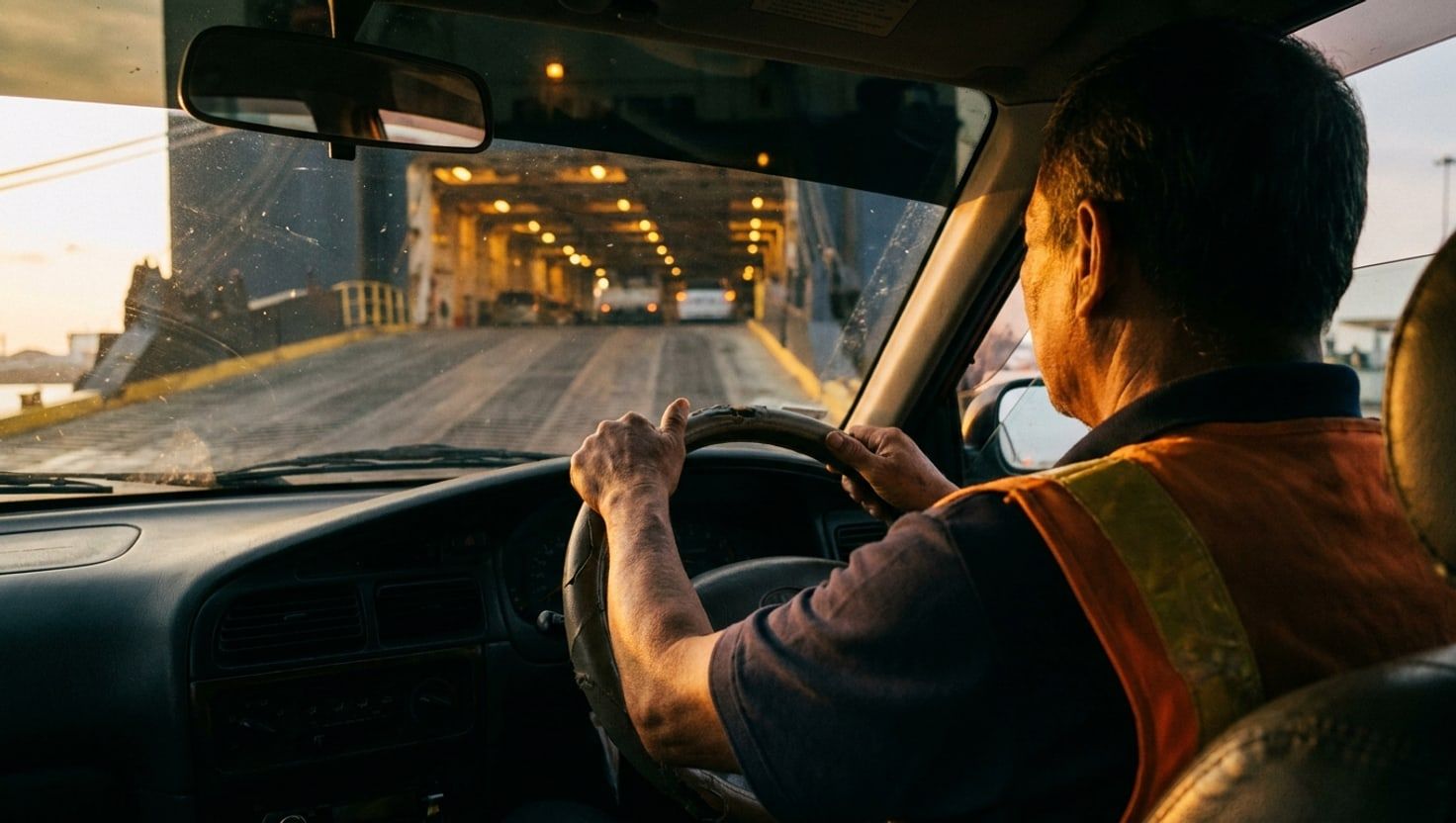

If you've ever seen "jockey drive" on a car-shipping quote and wondered what it means — simply put: someone drives your car for you, so you don't have to be at the port at all.
What Is Jockey Drive?
Jockey drive is a service where a professional driver (jockey) drives your vehicle on your behalf for the land legs of the shipment — from your pickup location to the yard/port in the Peninsular, and at the destination from the port to your address in Sabah/Sarawak. The car still crosses the sea by RORO; the jockey only handles the land driving.
Worth clearing up early: jockey drive does not mean your car is driven all the way to Sabah/Sarawak. The sea crossing is still done by the vessel. What actually gets driven is two short land legs — from your location to the loading port, and from the destination port to the receiving address. That's why the mileage added to the odometer stays small, and it's also why the service is the backbone of a door-to-door package: without a jockey, someone still has to drive the car on and off the ship.
How It Works
- 01
Pickup at your location
The jockey comes to your address, inspects the car with you, takes photos, and signs a handover form.
- 02
Drive to the yard/port
The jockey drives the car to our Klang yard, then to Port Klang to be loaded onto the RORO vessel.
- 03
Sea transit (RORO)
The car sails to the destination port. The jockey doesn't board the ship — the car is securely lashed on the deck.
- 04
Delivery at destination
A jockey/local agent collects the car at the port and drives it to your address in Sabah/Sarawak. Inspect & sign on receipt.
At every phase — handover, loading, arrival at the destination port, and final delivery — you get a short report with photos over WhatsApp. So even though you're never at the port, you still know where your car is and what condition it's in.
Handover and Inspection at Both Ends
The two moments that decide whether a jockey job goes smoothly are the two handovers, and both follow the same routine. At your address the jockey walks around the car with you standing there, photographs it — roughly a dozen frames at the doorstep — and fills in a condition form recording any damage that is already on the car. You both sign it and you keep a copy. Expect the whole thing to take about half an hour rather than five minutes; that is the inspection doing its job.
The car is photographed again, far more thoroughly, once it reaches the Klang yard: sixteen to twenty frames covering the four corners, every panel, the underside, the engine bay, the interior, the dashboard, the odometer reading, the VIN plate and the engine number. That second set is the record any claim would actually be assessed against, which is why it is more exhaustive than the set taken at your gate.
At the destination the sequence runs in reverse. The local agent collects the car at the port, drives it to your address, and you walk around it with the same condition report in hand before signing for receipt. This is the point to take your time. Compare the car in front of you against the photos, check the odometer against the figure logged at pickup, and raise anything that does not match before you sign rather than after. Taking your own dated photos at pickup — on your own phone, in your own hand on delivery day — costs nothing and makes that comparison much easier. The preparation guide has the full checklist.
Who Actually Drives Your Car
The people who do this work are drivers who load and unload vehicles every day, not casual hires picked up for a single job. It sounds like ordinary driving, and on an open road it is — but taking a car up a ship's ramp, threading it into a tight deck slot with centimetres to spare on either side, and positioning it over lashing points is a specific skill that gets better with repetition. That is the reason the work is given to the same pool of people rather than spread around.
Licensing depends on what is being moved. A private car needs a driver with the ordinary competent licence for that class. Commercial vehicles — lorries and similar — require a GDL licence issued by JPJ, and those jobs go to GDL-licensed drivers where the vehicle class calls for it. If you are shipping something heavier than a passenger car, that is worth raising at quote stage so the right driver is assigned from the start.
One detail surprises people: the jockey does not sail with your car. Once the vehicle is loaded and lashed on deck, it is in the vessel's hands, and a different driver or local agent takes over at the destination port. So two people drive your car during the shipment, at two different ends of the country, and both handovers are documented on the same condition report. Nobody is behind the wheel during the crossing itself.
Odometer, Fuel and Keys — What Actually Changes
Mileage. Because only the two land legs are driven, the distance added is short and bounded — your address to the loading port, and the destination port to the receiving address. The reading is logged before and after so the figure is not a matter of anyone's word. Write it down yourself before you hand the keys over; it takes a second and it is the simplest thing to check on delivery day.
Fuel. Arrive at about a quarter tank or less. This is not us saving on fuel — it is a safety requirement for the sea crossing, and a lower fuel level is the safer state for a vehicle sitting on a deck. A quarter tank is comfortably enough to drive the car on and off the vessel and complete both land legs. Turning up with a full tank is one of the more common reasons a pickup gets awkward.
Keys, toll tag and alarm. Hand over a single key and keep your spare. Take the SmartTAG or Touch 'n Go unit off the windscreen so it is neither lost nor charged during handling. Deactivate the car alarm, for the plain reason that an alarm going off on a car deck mid-voyage helps nobody and there is no one aboard who can silence it. And make sure the battery is healthy, because the car has to start under its own power at both ends of the crossing.
What stays in the car: nothing. Marine cover applies to the vehicle, not to the contents, and RORO carriers prohibit personal items being left inside regardless of value. Clear out documents, cash, electronics, child seats, and whatever has accumulated in the boot before the jockey arrives. If you genuinely need to move belongings alongside the car, say so at quote stage — the method and paperwork change, and that is far easier to arrange in advance than at the port.
Is Jockey Drive Safe?
Yes — with the right controls:
- 📷 Before & after photos document the car's condition at every handover.
- 🛡️ Marine Insurance covers the whole transit (warehouse-to-warehouse) — billed separately, per Insured Value.
- 📊 Odometer recorded before and after — mileage added is minimal (only to/from the port).
- 👨🔧 Experienced drivers who handle loading/unloading daily; GDL-licensed (issued by JPJ) for commercial vehicles where needed.
Who Is Liable — Land Leg vs Sea Leg
This is the question the safety bullets above don't fully answer, and it deserves a direct one. Cover is continuous across the whole journey, but it does not come from a single policy — different legs sit under different insurers, and knowing which is which tells you who to talk to if anything ever goes wrong.
- 🛣️ Origin land leg (the jockey drive): covered under Rentaka's commercial road transport insurance from the moment we take the car at your address.
- ⚓ The sea crossing: ICC(A) all-risks marine cargo cover, billed separately according to your vehicle's Insured Value — it is not folded into the shipping rate.
- 🛣️ Destination land leg: covered under our East Malaysia partner's commercial road transport insurance.
- 🏠 The pickup itself: operators carry public liability as well as commercial vehicle cover, so damage to a gate or driveway during collection is not your problem to absorb.
The practical implication of choosing jockey drive is that at no point is your own motor policy being asked to do the work. Hand the car to a jockey and every metre it moves is under someone's commercial cover. Drive it to the yard yourself under a port-to-port booking and that first leg sits under your own comprehensive policy instead — not worse, just yours rather than ours. Either way there is no gap in the chain; what changes is whose policy carries which leg. The door-to-door vs port-to-port guide sets the two chains out side by side.
Jockey Drive vs Doing It Yourself
With door-to-door jockey, you never have to go to the port — ideal if you're busy, have already relocated, or are shipping from another city. The port-to-port (P2P) option is cheaper if you hand over/collect the car yourself at the port. See the full comparison in the door-to-door vs port-to-port guide.
The way to weigh it up is simple: work out what handling it yourself actually costs you — the leave you'd have to take, the trip to the loading port, and the fare back from the destination port — then compare that against the door-to-door add-on. For customers who have already relocated or are shipping from another city, the jockey option usually comes out ahead.
When Jockey Drive Is the Wrong Choice
It is not the right answer for every shipment, and there are a few situations where booking it adds cost or delay without buying you much.
- 🔧 The car doesn't run. A jockey drives; a non-runner cannot be driven. Breakdowns and project cars are winched onto a flatbed instead, which still gets the vehicle to the port — it just isn't jockey work, so ask for it by name at quote stage.
- 📍 You're in the Klang Valley and the yard is an easy run. If dropping the car off yourself is a short detour rather than a day out, port-to-port is a perfectly sensible choice — it is roughly a third of shipments and local customers make up much of that.
- 👨👩👧 Someone can collect at the far end. Family or a friend near the destination port removes the reason for the destination leg entirely.
- ⏱️ You're booking at short notice. Both options want roughly a week to ten days ahead of the sailing you're aiming for, and door-to-door needs a day or two more on top to schedule the pickup. Genuine last-minute shipments are easier to place as port-to-port.
You are also not forced to choose one for the whole journey. Door-to-port and port-to-door each cover one end only, which suits the very common case where you need collection at home but someone at the destination can meet the ship. If access at your address is tight — a narrow lane, a low gate — say so when you request the quote rather than on pickup day, so a vehicle that actually fits is assigned to the job.
One expectation to set either way: the delivery date is a short window, not a fixed appointment, because sea transit depends on the vessel's schedule. You get a two-to-three day window at booking and a confirmed delivery date once arrival is certain, typically a day ahead. Plan the day you need the car around that window, not around the earliest date in it.
FAQ
What is jockey drive?
Jockey drive is a service where a professional driver (jockey) drives your vehicle on your behalf — from your pickup location to the yard/port, and at the destination from the port to your address. It's the backbone of door-to-door service.
Is jockey drive safe?
Yes. The vehicle is inspected and photographed before handover, covered by Marine Insurance throughout transit (billed separately, per Insured Value), and handled by experienced drivers. You receive a report + photos via WhatsApp at every phase.
How much mileage is added?
Minimal — only the drive from your pickup location to the port, and at the destination from the port to your address. We record the odometer before and after for transparency.
Who are the jockey drivers?
Experienced drivers who handle vehicle loading/unloading daily. For commercial vehicles like lorries, we use GDL-licensed drivers where needed.
Is jockey drive included in the price?
Jockey drive to/from the port is part of the service. Door-to-door pickup/delivery from your home adds +RM 250. The exact rate depends on location — check with our officer.
Can I drop the car at the port myself?
Yes — the port-to-port (P2P) option is cheaper if you hand over/collect at the port yourself. Door-to-door jockey is for those who want full convenience.
🚗 Want door-to-door jockey service?
We collect the car at your home and deliver it straight to your address in Sabah/Sarawak — you just fly there.
// Rentaka Logistics — vehicle shipping since 2023